


First-time homebuyers face significant challenges in today’s market due to a mix of high mortgage rates, increased home prices, and rigid lending standards. For many young professionals who are desperate to move out of their mundane dorm-style apartments, purchasing a condominium (condo) or a townhome provides a more budget-friendly option than a single-family home.
Housing Landscape Today
Although home prices have begun to stabilize in the U.S. housing market following several years of high inflation after COVID, there are still barriers to entry. Home prices are still close to 47% higher than they were in January 2020, making many first-time homebuyers feel priced out of the market. In fact, the annualized price growth average is 9.5%, which is almost double the historical average of 4-5%. Finally, homebuyers are dealing with some of the highest mortgage rates seen in the last decade (see chart below).
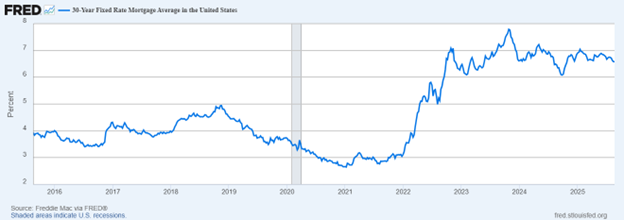
It may be helpful to know that even seasoned homebuyers have dealt with high mortgage rates in the past. The chart below highlights a well-functioning U.S. housing market over the past two decades that includes mortgage rates that were well above 6%.
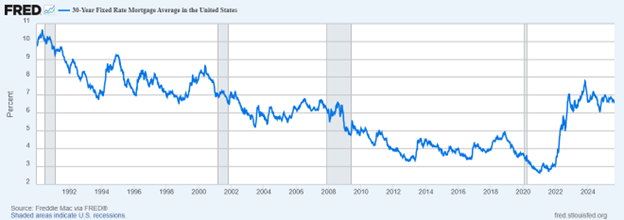
Even though prices are high and borrowing rates are elevated, there is hope for young professionals with strong balance sheets, budgets, and incomes. Homeownership is still attainable for first time buyers through the purchase of condos, townhomes, or less expensive single-family homes. We’ve provided a guide to help with the information needed to help make an informed purchasing decision.
Understanding the Role of a Homeowners Association (HOA)
Condos and townhomes are much more likely to have an HOA and associated fees based on shared walls, roofs, and common areas. HOAs are private, legally incorporated organizations that govern a housing community, collect dues for upkeep/maintenance, and set rules for its residents. The goals of an HOA are to help a community function properly, maintain a well-kept appearance, and provide additional recreational amenities. Ultimately, a well-maintained community also provides owners with property that ideally appreciates over time. An HOA bundles fees like roof repairs, landscaping, pool maintenance, and power washing, while the owner of a single home is responsible for all those costs on their own.
When reviewing an HOA, it’s important to do your due diligence on the prospective HOA’s financial stability. In addition to reviewing their financial reports, it is recommended to ask for a copy of their reserve funds to understand if there is potential for a special assessment. It’s also beneficial to ask about the HOA’s insurance coverage to understand if additional personal insurance might be needed. A special consideration for Florida residents: increased insurance costs have been impacting HOA monthly fees as well.
Build Out a Homeownership Budget
When building out a ‘homeownership budget’, it is best to understand what your monthly budget is for all relevant aspects of owning the condo or townhome.
The most effective way to think about your homeownership budget is your all-in monthly cost of owning your property. For a condo owner, this would include the mortgage principal and interest, property taxes, homeowners’ insurance, HOA fees, utilities, and expected maintenance.
Certified Financial Planner (CFP®) guidelines recommend that your monthly homeownership costs do not exceed 28% of your monthly gross income. As an example, if your household monthly gross income is $10,000, you would want to aim to keep monthly homeownership costs below $2,800 per month.
Additionally, if you carry other debt (student loans, car loans, or credit card debt), the CFP® guidelines recommend that your combined debt and homeownership costs do not exceed 36% of your monthly gross income.
Many of the costs of homeownership are fixed in your mortgage principal and interest payments so as your income increases, you have more flexibility with these percentages. Using these guidelines can help you and your realtor find a condo or townhome at a price point that best fits your budget.
Planning for a Down Payment
For those of you who are still a few years out from buying your first property, planning for a down payment can be daunting at first. Below are a few different methods investors recommend utilizing to save the necessary amount needed based on your comfort level of risk and timing.
For those of you that are risk-averse and planning to buy in the next 6 months, they might recommend putting your down payment into a savings account, allowing it to grow at a conservative pace. Today, most savings accounts tend to earn about 3-4% and maintain value through market turbulence.
For those of you who have more time to allow their down payment savings to grow and have a higher risk tolerance, investing in high-quality short-term fixed income options or the stock market are options to consider. These options allow for the potential of growth over time as they move closer to homeownership.
Please note, it is not recommended to put all your cash assets into the down payment. First-time homebuyers should have additional savings in place for any emergency needs (medical, new appliances, housing maintenance, etc.). Having an emergency fund gives you the ability to navigate life’s curveballs while also achieving your goal of homeownership.
Securing a Loan for a Condo or Townhome
The Federal Housing Administration (FHA) and Department of Veterans Affairs insure or guarantee loans from private lenders, making them more lenient for first-time condo and townhome buyers with lower down payments and flexible credit requirements. However, due to more frequent natural disasters, higher inflation, and increased property risks, these lenders have implemented tighter loan approval standards.
Katie Fiallo, Ullmann Wealth Partners’ new Client Services Associate, recently went through the process of buying a condo firsthand. Reflecting on the experience, she shared:
“I was floored by how many condo-specific requirements affected the approval process. I expected the lender to focus mostly on my credit and finances, but they also looked closely at the condo building’s financial health, insurance coverage, and even the percentage of owner-occupied units. Not all lenders were comfortable financing certain buildings, so I had to shop around more than I thought I would.”
It’s important to note that some condos or townhomes are considered ‘non-warrantable’ by the leading lenders in the industry. A few of the main factors these lenders utilize to determine if a condo is warrantable are high owner-occupancy rates, strong reserve funding for future repairs/maintenance, and a low percentage of investor-owned units.
To avoid this pitfall, it is recommended to ask your realtor to guide you toward known condos and townhomes that are not subject to these factors. You can also work with your lender early in the process, helping to create a smoother closing. You can also see which condo communities are approved or rejected by the FHA and the U.S. Department of Housing and Urban Development by visiting https://entp.hud.gov/idapp/html/condlook.cfm.
As you navigate buying your first property, we hope these tips give you confidence in your ability to properly plan for the right time to purchase your first home. Feel free to reach out with any questions or if you would like us to help plan your finances as you work toward securing your first home.