

Hello Ullmann Wealth Family! My name is Luke, and you might remember me from a previous blog. I graduated from high school in 2024 and am currently attending the University of North Florida (UNF), while interning at Ullmann Wealth Partners. My dream school was the University of Florida (UF), putting all my effort into getting accepted, but when I got my letter back, my heart sank at the rejection. But pivoting to UNF turned out to be one of the greatest blessings of my life, and writing this blog is a testament to that. I went through this process without much of a roadmap, and my goal is to give you the guidance I wish I’d had.
To make this even more useful, I interviewed Darla Neal, a local college counselor with years of experience guiding students through this process. Her insights, paired with my experience, will create a unique perspective on how to take on this challenge.
As you may know, the admissions landscape has never been more competitive. According to College Match Point’s 2025 analysis, a record 17 colleges now have admit rates below 10%, including schools that were far more accessible just a few years ago. But competition doesn’t mean hopelessness; there is more opportunity and more funding available than most families realize. You just need to know where to look.
One valuable resource to help you and your child start is a school’s common data set that they post every year, which shows all the statistics from the admitted students that year, like what the average GPA was and more. Below is UF’s data set on their criteria. I highly recommend looking into the schools that are of interest to your child.
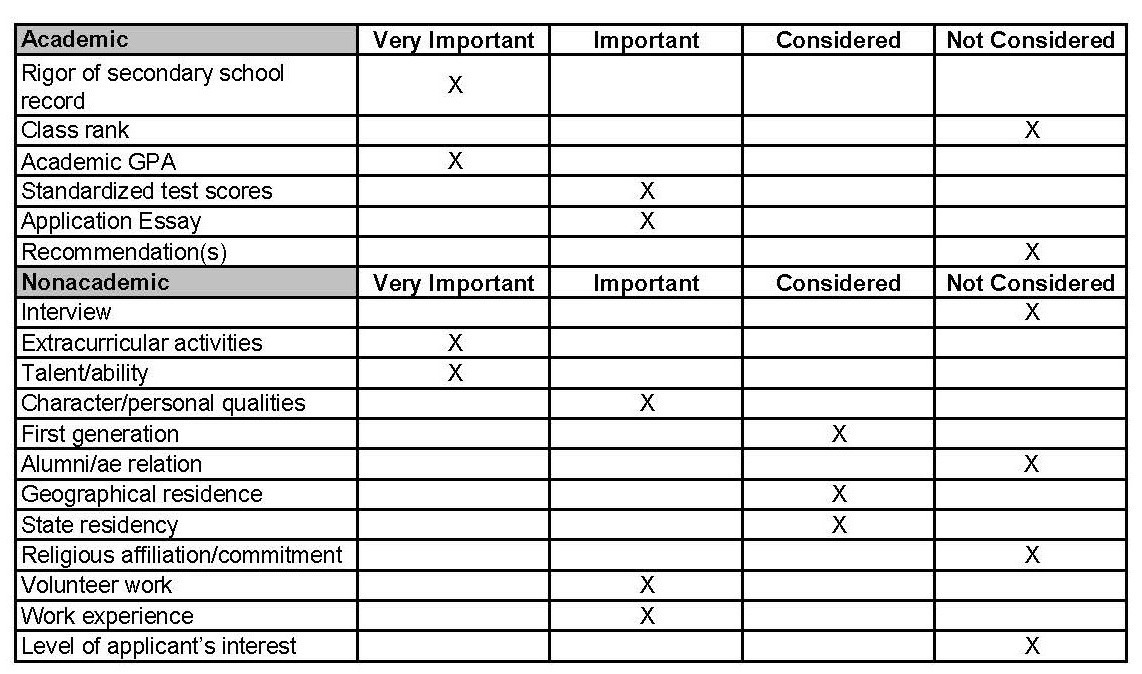
Image source: University of Florida Common Data Set 2024–2025
Part 1: The College Application

Every school weighs things differently, so the first step is looking up a school’s published admissions data to understand what they prioritize. That said, four factors show up everywhere: your transcript, test scores, the essay, and extracurriculars.
Start Earlier Than You Think
One of the most common mistakes families make is waiting until junior or senior year to start thinking about the best college fit. Darla recommends campus visits as early as 8th to 10th grade, not to narrow down specific schools, but to develop a sense of preferences: size, environment, pace, and setting.
When it comes to building the actual list, Darla focuses on four areas of college fit: academic, financial, social, and logistical. That last one surprises a lot of families. Distance from home and ease of travel matter far more than people expect — especially in the first year. As for how many schools to apply to, 8–12 is still a solid range.
The Transcript: Still the Foundation
When admissions officers open an application, the first thing they look at is the transcript, not just the number of your GPA. According to Darla, most colleges recalculate it based on the core classes and evaluate performance in the context of rigor. Alignment also matters, so if a student is applying for engineering, then they expect to see strength in math and science. This is something I saw firsthand. In high school, students were loading up on AP and dual-enrollment courses not just to learn more, but to push their GPA higher than their peers’.
Test Scores
Over 80% of colleges are now test-optional, but if your child is targeting a selective school, a strong score is still a meaningful differentiator. The practical advice: take the test, prepare well, and if the score is competitive for a target school, submit it. If it’s not, most schools will simply evaluate the application without it.
The Essay: Where Personality Wins
In a test-optional world, the essay carries more weight than ever. A great personal statement can get a student into a school that their transcript alone might not. I saw it happen to classmates with lower academic profiles who invested in their essays and ended up at more selective schools. The essay must not be a wordy resume, but rather a personal reflective take on your life that shows a person’s growth, self-awareness, and true character. It’s important to have your child start early, write from a real place, and resist the urge to polish out all the personality. The discomfort of writing something honest is usually a sign they’re on the right track.
Extracurriculars: Depth Over Breadth
Colleges want to see genuine commitment, not a padded list. Two or three activities pursued with real passion — ideally connected to your child’s intended area of study — will outperform ten surface-level interests. Summers matter too: work, volunteer, shadow a professional, or join a program that builds relevant skills. It strengthens the application and, more importantly, helps your child figure out what they want to do.
Part 2: Funding College — Where the Money Is

College is expensive, but there is far more financial support available than most families realize. Think of it in four buckets: federal and state aid, school scholarships, local scholarships, and national programs.
1. Free Application for Federal Student Aid (FAFSA) First
File the FAFSA as early as possible after October 1st of senior year — even if you think your income disqualifies you for need-based aid. Many school-specific and state scholarships require it regardless of household income. Don’t skip this step.
2. School Scholarships — the Biggest Opportunity
This is where Darla and I completely agree: most families underestimate how much scholarship money is tied directly to the admissions decision itself. UNF, for example, awards scholarships to incoming freshmen who meet certain GPA and test score thresholds. A strong application doesn’t just open doors; it can significantly reduce what you pay as well.
3. Local Scholarships — the Hidden Gold
After school itself, go local. Focus on community organizations, religious institutions that your child may be a part of, or civic groups, and employer programs. There are scholarships everywhere. I’ll back that up with my own experience: I won $2,500 from the Rotary Club in high school, a club I had barely attended. I showed up a few times but was still eligible to apply, and I won! Lots of these scholarships have less competition as well. Just apply, you never know what you might win.
4. National Platforms
Lastly, national scholarships are an option. For scholarship searches, Scholarships360 and Bold.org are solid starting points, along with your state’s higher education agency website. Unfortunately, due to their size, there is a lot of competition and less likelihood of winning them. But again, you never know. Another important notice is that any scholarship that charges a fee to apply is a scam. Stack smaller awards together; $500 and $1,000 scholarships add up to real money with far less competition than the big national ones.
The Bigger Picture: Take the Pressure Off
The “dream school” mindset puts enormous pressure on kids and parents, often blinding families to genuinely great options. Even strong students get rejected for reasons they’ll never fully understand. A student’s success has far more to do with what they do in college than where they go.
Your role as a parent is to help them find a school they’re genuinely excited about being in, not just a name that sounds impressive. And as Darla puts it, the goal isn’t just acceptance — “It’s finding a place where your child will succeed and be comfortable".
I encourage parents to start touring colleges early in high school. Get your kids thinking about the future now and excited about opportunities ahead, so they stay motivated to work towards a school that they will enjoy and that fits their needs. Don’t be afraid to ask for help either. Counselors like Darla are worth the investment, and working with your financial planning firm can help to set your child up for long-term financial success.
I didn’t get into my dream school, and it turned out to be one of the best things that ever happened to me. UNF led me to an internship I love, a career path I’m excited about, and the opportunity to share my experience with you. The “right” school is the one that opens the right doors for your child. There are more of those doors out there than you might think.